
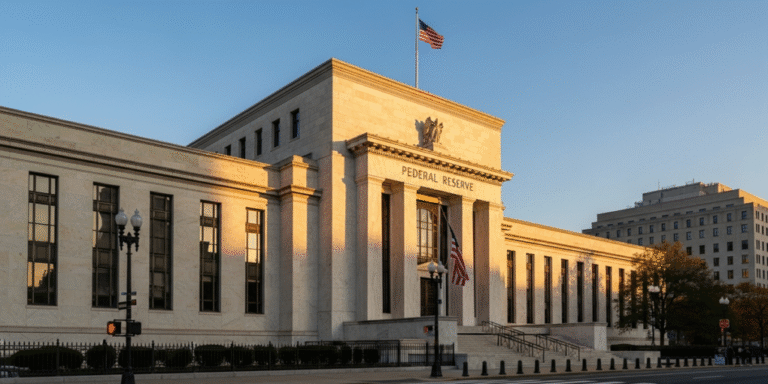
Jerome Powell ran the Federal Reserve for eight years.
During that time, inflation hit 40-year highs. Interest rates whipsawed from near-zero to levels that crushed homebuyers. The Fed’s balance sheet ballooned to $6.6 trillion. And the central bank spent time and resources joining global climate change groups, implementing ESG frameworks, and pursuing DEI initiatives.
In November, Kevin Warsh wrote in the Wall Street Journal that “inflation is a choice, and the Fed’s track record is one of unwise choices.”
On Friday, Trump nominated him to replace Powell.
The era of the activist Fed is over.
Powell’s Fed Lost the Plot
The Federal Reserve has two mandates, set by Congress: maximum employment and stable prices.
Two jobs. That’s it.
Under Powell, the Fed decided those two jobs weren’t enough. It joined global climate change organizations. It embedded ESG — Environmental, Social, and Governance — criteria into its decision-making. It launched DEI programs. It expanded its economic footprint into areas that have nothing to do with monetary policy.
E.J. Antoni, chief economist at the Heritage Foundation, put it bluntly: “Under Powell, the Fed has engaged in egregious mission creep, taking its eye off the prize of conducting sound monetary policy and instead focusing on ESG, DEI, and other far-left causes.”
While Powell was virtue-signaling about climate, inflation was eating American families alive. Groceries up 25%. Housing costs at record levels. Real wages declining for two consecutive years.
The Fed wasn’t watching prices. It was watching its carbon footprint.
Warsh Is the Opposite of Powell
Kevin Warsh served on the Fed’s Board of Governors from 2006 to 2011. He navigated the 2008 financial crisis from inside the institution.
He knows how the Fed works. He also knows what’s broken.
Antoni describes the difference as fundamental: “Warsh’s understanding of monetary policy is reflective of actual history and empirical evidence — the exact opposite of Powell.”
The opposite. Not a slight adjustment. Not a moderate course correction. The opposite.
“We can therefore expect very different results including a much more stable dollar and much less volatility in interest rates,” Antoni continued.
A stable dollar means your savings hold their value. Less rate volatility means businesses can plan, families can budget, and the housing market isn’t whipsawed between boom and bust every 18 months.
“Top to Bottom Regime Change”
Warsh himself called for “regime change” at the Fed in November.
Antoni says that’s exactly what his chairmanship would deliver.
“Warsh would undo all of that and return the Fed’s focus where it belongs. Additionally, Warsh understands that many of the Fed’s economic models are deeply flawed and contrary to the historical evidence, so we can expect he would also address this issue. It would be top to bottom regime change under his chairmanship.”
The Fed’s economic models failed to predict the inflation crisis. They told Powell inflation was “transitory” — a word that became a punchline as prices surged month after month. The models said supply chains would normalize. They didn’t. The models said rate hikes would cool inflation quickly. They didn’t.
Warsh recognizes that the models themselves are broken. Not the inputs. The architecture.
Replacing flawed models with frameworks grounded in historical evidence would be the most consequential reform at the Fed in decades.
The $6.6 Trillion Balance Sheet
When the 2008 financial crisis hit, the Fed began buying Treasury securities and mortgage-backed securities to inject liquidity into the economy. The balance sheet grew.
During COVID, it grew even more — massively. The Fed’s total assets hit nearly $9 trillion at peak.
Today they sit at $6.6 trillion. Still enormous. Still distorting markets.
Warsh has called the bloated balance sheet a relic of “a bygone crisis era” that supports “the biggest firms” at the expense of the broader economy.
He wants to reduce it significantly.
Jason Sorens, an economist at the American Institute for Economic Research, explained what that means: “By reducing the federal funds target rate and selling assets in tandem, the Fed should be able to reduce interest rates without raising inflation.”
Lower rates without higher inflation. That’s the holy grail of monetary policy. And it’s achievable — if the balance sheet is unwound carefully and liquidity regulations on banks are adjusted simultaneously.
The Interest on Reserves Scam
Here’s something most Americans don’t know about.
The Fed currently pays interest on reserves that large commercial banks hold at the central bank. Billions of dollars per year flowing from the Fed to the biggest banks in America — simply for parking money.
Jai Kedia of the Cato Institute says Warsh’s balance sheet reduction “must be coupled with the elimination of the interest on reserves program which pays large corporate banks billions of dollars in interest payments.”
Read that again. The Federal Reserve is paying the biggest banks in the country billions of dollars in interest — essentially a subsidy — for doing nothing.
Every dollar the Fed pays in interest on reserves is a dollar that comes from somewhere. It distorts monetary policy, inflates bank profits, and keeps the financial system dependent on Fed largesse.
Warsh wants to end it. That alone would represent a seismic shift in how the financial system operates.
What This Means for Mortgage Rates
Trump promised during the campaign to bring mortgage rates back down to 3%.
Rates currently sit around 7%. The difference on a $400,000 home is roughly $600 per month — the difference between affording a home and being locked out.
Sorens offers an important caution: aggressive rate cuts could temporarily reduce real rates but ultimately produce “permanently higher interest rates” — exactly what happened in 2020-2023.
“For long-term low interest rates, it’s better to have macroeconomic stability, which means not trying to push rates down in the short term.”
Warsh understands this. His approach would prioritize stability over short-term stimulus. Get inflation genuinely under control. Shrink the balance sheet. Reduce the Fed’s market distortions. Let rates normalize based on actual economic conditions rather than central bank manipulation.
The result: sustainable low rates built on a foundation of stable prices. Not temporary low rates that trigger an inflationary spiral.
No More Climate Activism at the Fed
Under Powell, the Fed joined the Network for Greening the Financial System — a global climate change organization.
A central bank. Joining a climate group.
The Fed began incorporating climate risk into its supervisory framework, treating carbon emissions as a financial stability concern. It signaled to banks that lending to fossil fuel companies carried enhanced regulatory risk.
This had real consequences. Banks tightened lending to energy producers. Oil and gas companies faced higher borrowing costs. Energy prices rose — contributing to the very inflation the Fed was supposed to be fighting.
Warsh will end all of it. No more climate groups. No more ESG supervision. No more using monetary policy to pursue environmental objectives that Congress never authorized.
The Fed will return to its two mandates: maximum employment and stable prices. Period.
Rules-Based Monetary Policy
Kedia identifies the most important potential reform: “Implement rules-based monetary policy.”
Under the current system, the Fed makes interest rate decisions based on the judgment of a small group of officials meeting behind closed doors. Those decisions are influenced by economic models, political pressure, market expectations, and institutional bias.
Rules-based policy would replace subjective judgment with transparent, predictable frameworks. If inflation exceeds a certain threshold, rates adjust automatically. If employment falls below a target, the response is predetermined.
Predictability reduces volatility. Transparency reduces political manipulation. Rules reduce the possibility of the kind of catastrophic errors that produced the 2021-2023 inflation crisis.
Powell’s Fed operated on vibes. Warsh’s Fed would operate on rules.
Congress Still Matters
Kedia offers an important caveat: many of Warsh’s most ambitious reforms “are likely to lead nowhere without Congress issuing legislation.”
The Fed’s structure, mandates, and authority are defined by law. A chairman can change culture, priorities, and policy approaches. But fundamental structural reform — like eliminating interest on reserves or implementing rules-based policy — requires legislation.
Republicans hold the House by a narrow margin. The Senate is closely divided. Passing Fed reform legislation would require political capital and prioritization.
Whether Trump and Congress invest that capital will determine whether Warsh’s chairmanship produces lasting change or temporary improvements.
The Markets Called Him “Hawkish.” Good.
Markets initially interpreted Warsh’s nomination as “slightly hawkish.”
In market language, hawkish means less likely to cut rates aggressively. Less likely to flood the economy with cheap money. Less likely to bail out reckless borrowers.
For Wall Street, that’s a warning. For Main Street, it’s a promise.
A hawkish Fed protects savings. Preserves purchasing power. Maintains the value of wages. Ensures that working Americans aren’t robbed by inflation engineered to benefit asset holders.
Powell’s dovish Fed made the rich richer through asset inflation while eroding the wages and savings of everyone else.
Warsh’s hawkish approach prioritizes the stability that working families need over the stimulus that Wall Street wants.
That’s not just good economics. That’s justice.